


Your child can't stay seated at dinner, forgets half the instructions you just gave, and melts down when the plan changes. At school, the teacher mentions blurting, wandering attention, and trouble joining peer conversations. At home, you notice something else too. Your child may talk at length about one favorite topic, miss social cues, or seem unusually upset by noise, clothing textures, or small disruptions.
That mix leaves many parents searching for “aspergers vs adhd” and hoping for a clean answer. In practice, it often isn't clean. Some children fit one profile clearly. Many don't. What families need isn't a label contest. They need a practical way to understand what's driving the behavior, what supports the brain, and what to do next.
I approach this as a child psychiatrist with a strong integrative lens. Diagnosis matters, but daily life matters just as much. Sleep, movement, nutrition, school fit, therapy, family routines, and sometimes medication all influence how well a child functions. If your child has autistic traits, That's Okay's guide for autism support is a useful parent-friendly companion for thinking through day-to-day support at home. Families also often benefit from broader guidance on parenting a child with autism as they sort through overlapping concerns.
This article is educational. It isn't intended to diagnose or treat any medical condition, and it isn't a substitute for professional medical advice, diagnosis, or treatment. If you're considering testing, medications, or supplements, discuss those decisions with a qualified healthcare professional who knows your child.
A Parent's Guide to Navigating Neurodiversity
Parents usually notice the pattern before anyone else does. They see the child who's bright and curious but misses the joke, interrupts constantly, gets stuck on one idea, or falls apart when a routine shifts. They also see the cost. Homework becomes a nightly battle. Playdates feel unpredictable. Simple transitions can turn into long, exhausting evenings.
The reason this feels confusing is that the same outward behavior can come from different underlying processes. A child may avoid a group activity because they're distracted and impulsive. Another child may avoid that same activity because they don't read the social rules easily or feel distressed by the noise and unpredictability. The behavior looks similar. The reason behind it isn't.
Many parents come in asking which label is “right.” The more useful question is often, “What pattern does my child show across attention, social communication, flexibility, and regulation?”
A helpful starting point is to think less about winning a diagnostic debate and more about mapping your child's strengths and friction points. Ask yourself:
- Attention: Does your child lose track, drift off, or jump between tasks?
- Impulse control: Do they act before thinking, interrupt, or have trouble waiting?
- Social understanding: Do they misread tone, body language, or conversational rhythm?
- Flexibility: Do changes in plans create unusual distress?
- Interests and repetition: Do they return to the same topics, movements, or routines in a way that feels more intense than peers?
That kind of observation gives a clinician better material than a vague statement like “something just feels off.” It also helps you spot where support is needed right now, even before the full evaluation is complete.
Understanding the Core Clinical Definitions
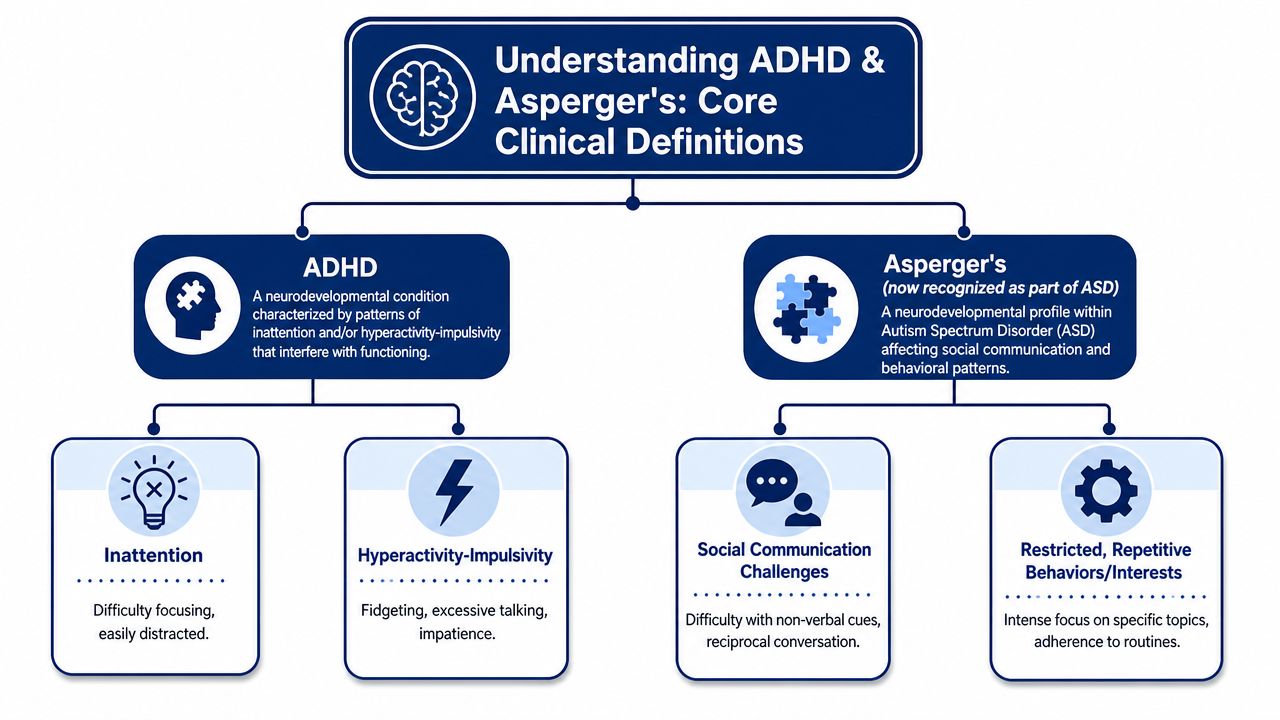
The first step in any aspergers vs ADHD discussion is using current clinical language correctly. “Asperger's syndrome” is still a term many families use, but it's no longer a separate diagnosis. In 2013, the American Psychiatric Association folded Asperger's into autism spectrum disorder, or ASD, so current assessments distinguish ASD from ADHD rather than treating Asperger's as a standalone label, as explained in this review on the difference between autism, ADHD, and Asperger's.
ADHD in plain language
ADHD is a neurodevelopmental condition defined by problems with inattention, hyperactivity, and impulsivity. Not every child has all three in the same way. Some are constantly in motion and impulsive. Others mainly seem spacey, disorganized, and mentally elsewhere.
Large surveillance data show how common ADHD is. The CDC reported that an estimated 7 million U.S. children ages 3 to 17 years, or 11.4%, had ever been diagnosed with ADHD in 2022, and childhood rates stayed relatively stable from 10.08% to 10.47% from 2017 to 2022, according to the CDC's ADHD data and statistics. If you want a practical overview of symptoms and presentations, this guide on what ADHD looks like in children can help translate clinical language into everyday examples.
ASD including what many still call Asperger's
ASD is defined by persistent differences in social communication and the presence of restricted or repetitive behaviors, interests, or routines. Some children talk early and have strong vocabulary, which is one reason older generations may still use the term Asperger's. Even so, the clinical frame is now ASD.
A child with ASD may struggle with back-and-forth conversation, nonverbal cues, flexible thinking, or coping with change. They may also have intense interests, sensory sensitivities, or a strong need for sameness.
A quick comparison
| Feature | ADHD | ASD |
|---|---|---|
| Core difficulty | Attention regulation, inhibition, impulsivity | Social communication, flexibility, repetitive patterns |
| Common school picture | Distracted, restless, incomplete work | Social misunderstanding, rigidity, intense interests |
| Conversation style | Interrupts or drifts off | May be one-sided, literal, or miss social nuance |
| Response to routine | Often forgets routines | May depend heavily on routines |
Clinical shortcut: ADHD often looks like “I can't hold the lane.” ASD often looks like “I need the lane to stay predictable.”
Symptom Comparison Across Different Ages
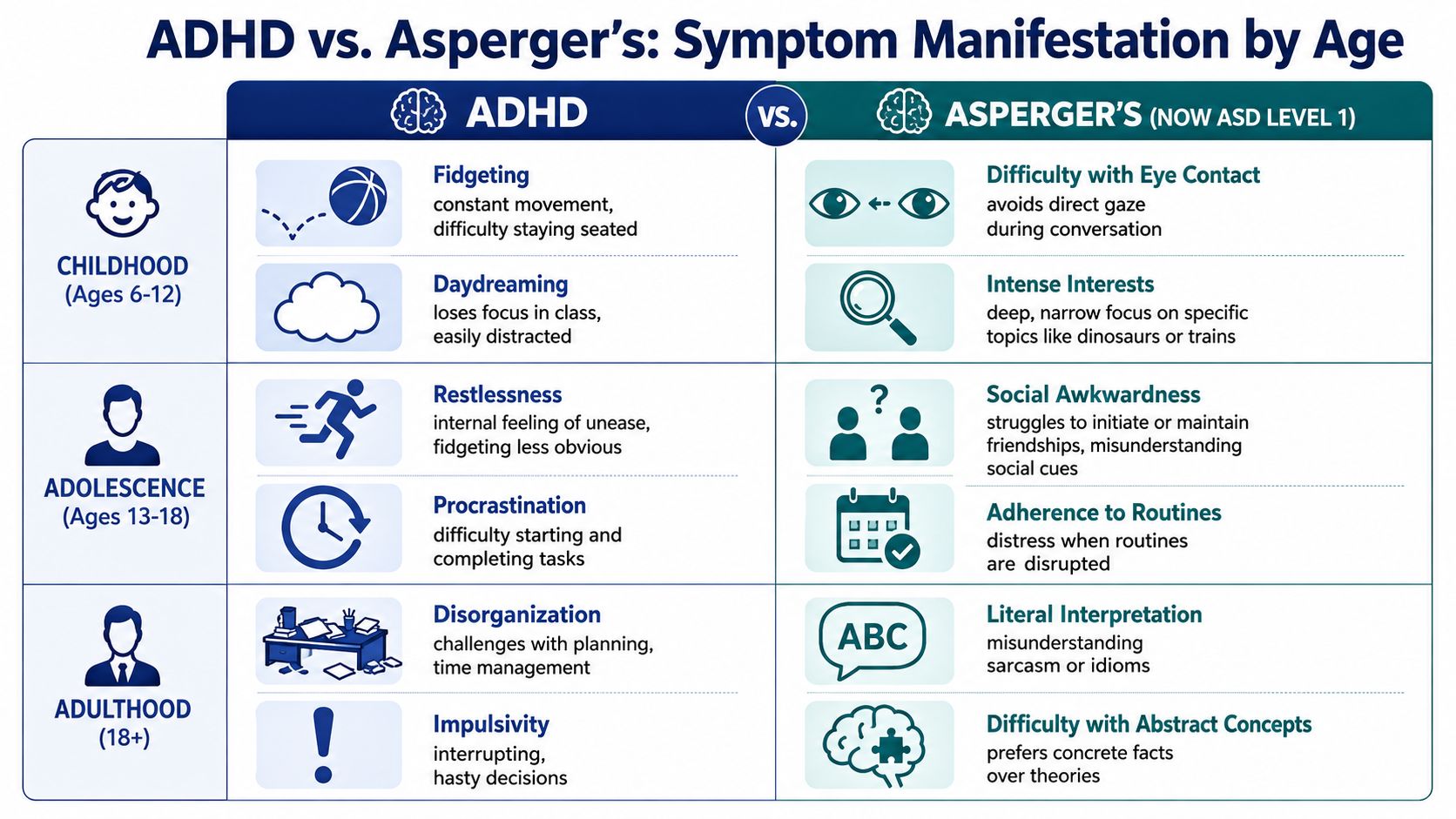
Parents often say, “The lists online all sound similar.” That's true on the surface. The better way to compare aspergers vs ADHD is to look at the why behind the behavior, and to see how it changes with age.
A key clinical distinction is that ADHD primarily impairs inhibition and sustained attention, while ASD is more associated with cognitive flexibility deficits and restricted or repetitive behavior. When both are present, executive-function impairment is often more severe, as described in this clinical review on executive function in ADHD and ASD.
Preschool years
In preschool, both conditions can look like “busy behavior,” but the pattern differs.
With ADHD, the child may dart from toy to toy, climb unsafely, ignore instructions, and seem unable to pause before acting. The social trouble often comes from impulsivity. They grab, blurt, crowd, or interrupt because the brake system is weak.
With ASD, the child may play in a more repetitive or narrow way, struggle with shared pretend play, resist transitions, or seem less tuned in to facial expressions and social reciprocity. Some preschoolers seem content talking at people rather than with them.
- Social interaction in ADHD: Wants to join, but barges in awkwardly.
- Social interaction in ASD: May want connection but not grasp the unwritten rules.
- Play pattern in ADHD: Rapidly shifting, novelty-seeking, hard to sustain.
- Play pattern in ASD: Focused, repetitive, sometimes rigid.
If a preschooler is both impulsive and unusually inflexible, don't assume one diagnosis explains everything.
School-age years
This is when the difference becomes clearer because the social and academic demands rise quickly.
A child with ADHD may understand the lesson but miss key details, lose materials, forget to turn in completed work, and make careless mistakes. In conversations, they may talk over others, wander off topic, or miss parts of what was said because attention dropped.
A child with ASD may perform well in factual or preferred areas but struggle with group work, perspective-taking, figurative language, and the hidden curriculum of the classroom. They may follow rules to the letter or become distressed by schedule changes.
Side-by-side examples
| Domain | More typical in ADHD | More typical in ASD |
|---|---|---|
| Friendships | Conflict from impulsivity or inconsistency | Conflict from misunderstanding cues or reciprocity |
| Attention | Distracted by many things | Can focus intensely on preferred interests |
| Transitions | Forgets or resists because attention shifts poorly | Resists because change itself feels disruptive |
| Classroom behavior | Fidgeting, blurting, unfinished tasks | Rigidity, sensory overload, narrow interests |
Teen years
Teens often mask more, so symptoms can become harder to read.
In ADHD, hyperactivity may look less like running around and more like inner restlessness, procrastination, disorganization, emotional reactivity, and poor follow-through. The teen may desperately want to do well and still miss deadlines.
In ASD, the teen may become more aware of social differences and feel exhausted by trying to decode peers. They may appear awkward, overly formal, literal, or highly dependent on routines that help them feel stable.
A useful real-world distinction
- If the main issue is inhibition, the teen often says things too fast, acts too soon, or starts ten tasks and finishes two.
- If the main issue is flexibility, the teen often gets stuck, needs sameness, struggles with ambiguity, or becomes overwhelmed when social or sensory demands shift.
That distinction matters because support should target the underlying mechanism, not just the visible behavior.
The Foundational Role of Diet and Supplements
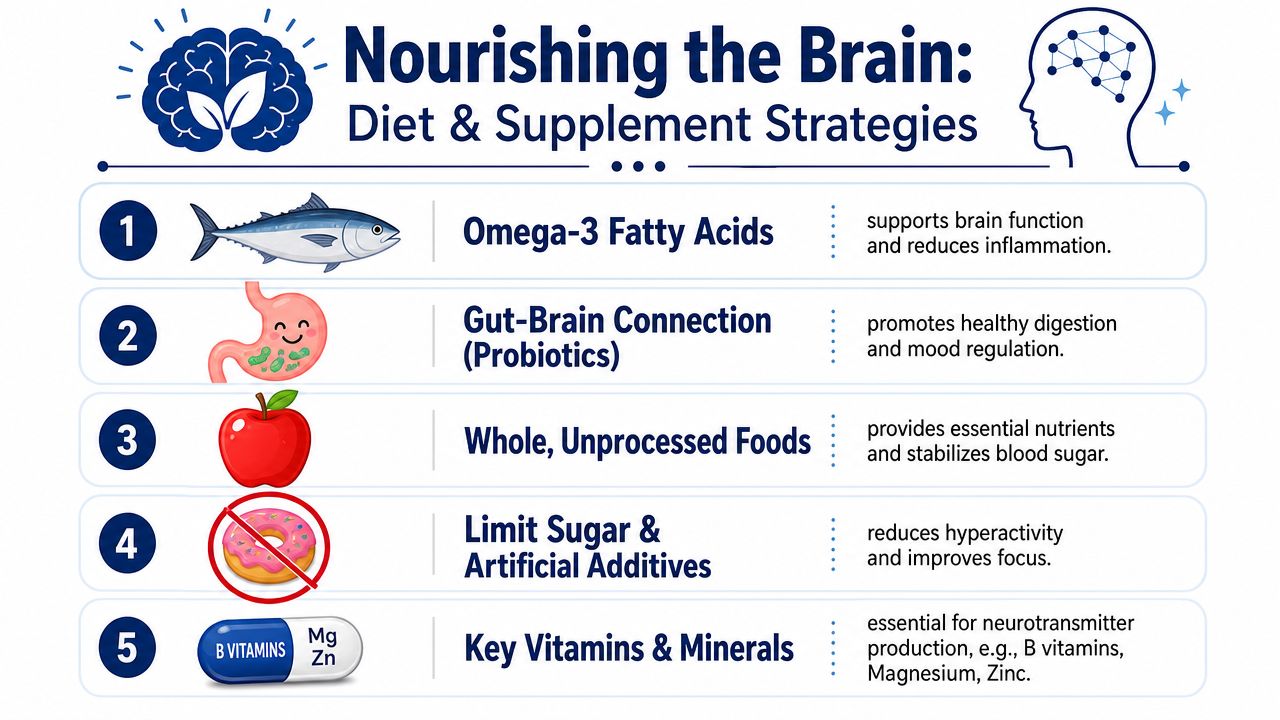
Food won't erase ADHD or ASD, but nutrition shapes attention, energy, sleep, mood regulation, and resilience. Families sometimes swing between two extremes. They either expect diet to fix everything, or they assume it doesn't matter at all. Neither view helps.
The practical middle ground is better. Build a steady, brain-supportive foundation, look for nutritional weak spots, and make changes your family can maintain.
What to look at first
Children with attention problems, restricted eating, sensory aversions, or highly repetitive diets may not be getting enough of certain nutrients. In practice, I think first about iron, zinc, magnesium, protein intake, and overall meal regularity. I also pay attention to constipation, bloating, frequent stomach discomfort, and very selective eating, because those issues can worsen regulation and behavior.
Some parents find it useful to learn more about the relationship between digestive health and brain function, especially when appetite, bowel habits, stress, and food selectivity all seem tangled together.
A reasonable home checklist includes:
- Protein at breakfast: Eggs, Greek yogurt, cottage cheese, nut butter, tofu, or leftovers from dinner.
- Steady blood sugar: Pair carbohydrates with protein or fat instead of relying on sweet cereals, pastries, or juice alone.
- Color and fiber: Fruit, vegetables, beans, lentils, oats, and whole grains support satiety and gut health.
- Hydration: Some children look more irritable and foggy when they're underhydrated.
Omega-3s and how to choose them
Omega-3 supplements are one of the most common integrative tools parents ask about. They're popular for a reason. They support brain structure and function, and many families want a simple step they can discuss with their clinician.
What matters most is choosing a product thoughtfully.
- Check the label for EPA and DHA. Don't focus only on the front-of-bottle “fish oil” amount. Look for the actual omega-3 content.
- Choose third-party tested brands. Purity testing helps reduce concern about contaminants and label inaccuracy.
- Pick a form your child will take. Liquid, mini-softgel, gummy, or algae-based options all exist.
- Start with affordability and consistency. A basic, well-tested fish oil is often more realistic than an expensive specialty product that a child refuses after a week.
For families who avoid fish, algae-based omega-3 supplements can be a practical alternative. For budget-conscious households, frozen salmon, canned salmon, sardines, tuna used thoughtfully, chia seeds, ground flax, and walnuts can help build a more brain-healthy pattern without overcomplicating meals.
Later in the conversation, some families also ask about probiotics and food variety. This overview may help frame the discussion:
Unhealthy habits that quietly work against progress
Three patterns regularly undermine children who are already vulnerable to dysregulation:
- Skipping meals: This often worsens irritability and poor focus.
- Ultra-processed grazing: Kids stay full enough to reject real meals, but undernourished in the ways that matter.
- High-caffeine or energy-drink habits in older kids: These can destabilize sleep, appetite, and anxiety.
Food works best as infrastructure. It's not a replacement for good assessment, but it often determines how much benefit a child can get from everything else.
Building Brain-Healthy Habits and Routines
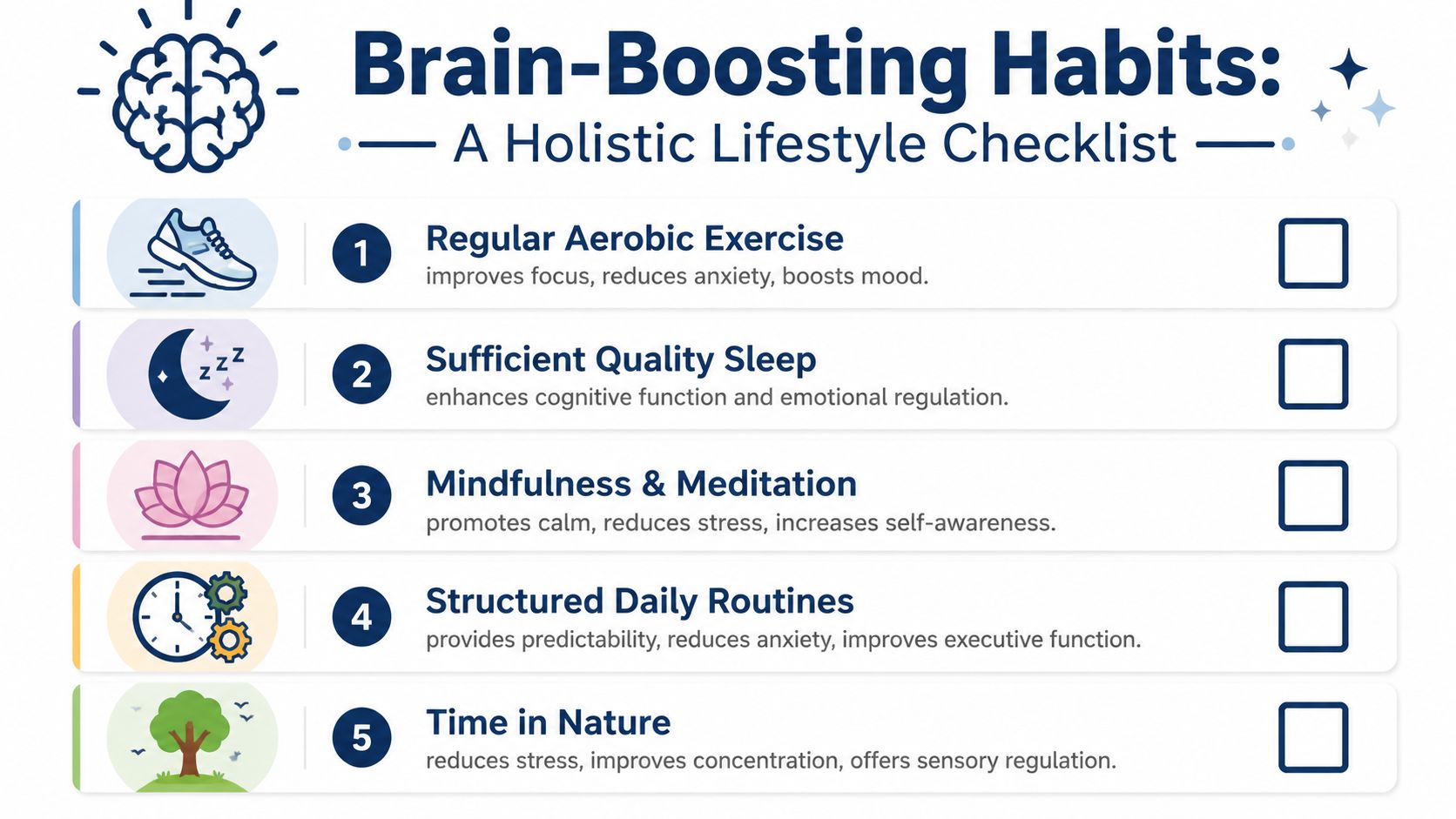
If I had to pick one non-food intervention that helps the greatest number of kids, I'd pick exercise. Not because it solves every symptom, but because it improves attention, mood regulation, sleep pressure, stress tolerance, and body awareness all at once.
For children with ADHD, movement often helps discharge restlessness and improves readiness to focus. For autistic children, the right kind of movement can regulate sensory input, reduce stress, and create a more predictable rhythm for the day.
Exercise that actually works for families
Parents often hear “get more exercise” and immediately think of organized sports. That works for some children, but not for all. The right activity is the one your child can tolerate, repeat, and sometimes enjoy.
Good options include:
- Aerobic movement: Walking, biking, swimming, trampoline time, dancing, or family hikes.
- Heavy work: Carrying groceries, pushing a loaded laundry basket, climbing, playground time, resistance bands.
- Rhythmic exercise: Martial arts drills, rowing motions, scooter boards, jump rope, or dribbling practice.
- Nature-based activity: A park loop after school can calm a child faster than another hour indoors.
Aim for movement at predictable times. After school is often ideal because it lowers stress before homework and bedtime.
Sleep and the bedtime reset
Sleep problems amplify almost every symptom families worry about. A tired child is usually more distractible, more rigid, more impulsive, and less socially flexible.
A solid sleep routine usually includes:
- Consistent timing: Similar wake and sleep times every day.
- Screen reduction: Keep stimulating content out of the final part of the evening.
- Sensory support: Dark room, cool temperature, and bedding your child can tolerate comfortably.
- Predictable sequence: Bath, pajamas, reading, calming music, lights out.
A child who “won't listen” at night is sometimes a child whose nervous system never got a clear signal to downshift.
Daily structure and unhealthy habits to watch
Children with ADHD and ASD usually do better when adults externalize structure instead of repeating verbal reminders. Visual schedules, checklists, labeled bins, timers, and transition warnings reduce conflict because the system carries some of the load.
Excessive screen use is one of the most common unhealthy habits I see. It can crowd out sleep, movement, conversation, and boredom tolerance. It also makes transitions harder because the brain gets used to constant stimulation.
For older kids who struggle with planning, systems matter more than motivation. Families looking for practical ideas may find these systems for ADHD time management helpful when they're trying to reduce lateness, forgotten tasks, and homework gridlock.
A few low-cost daily habits punch above their weight:
- Two-minute breathing reset before homework
- Ten-minute outdoor break after school
- Simple visual morning checklist
- Family walk after dinner
- Quiet hobby before bed instead of fast-paced screens
Navigating Assessment and Treatment Pathways
When a child shows a mixture of social, attention, sensory, and behavior concerns, a narrow evaluation often misses the complete picture. That's one reason this topic frustrates families. They may hear “it's just ADHD” from one setting and “it's autism” from another, when the child may need a broader look.
Published reviews report that roughly 50% to 70% of autistic individuals also meet criteria for ADHD symptoms, which is why a thorough evaluation for both conditions is often recommended when a child presents with attention or social difficulties, as summarized in this review of ADHD and Asperger's overlap.
What a comprehensive evaluation should include
A strong assessment usually pulls from multiple sources, not one quick office impression.
That often includes:
- Parent history: Pregnancy and birth history, early development, language, sensory patterns, routines, behavior, sleep, and family mental health history.
- School input: Teacher reports, academic performance, peer functioning, classroom behavior, and whether the child can manage less structured settings.
- Symptom mapping across settings: Home, school, extracurriculars, and social situations.
- Rule-outs and co-occurring issues: Anxiety, learning disorders, depression, sleep problems, trauma, and language or social-pragmatic differences.
If you're preparing for formal testing, it helps to understand the ADHD evaluation process, especially what information parents and schools are usually asked to provide.
How treatment works when the goal is function
The right treatment plan improves function, not just symptom checklists. That usually means combining supports rather than betting on one tool.
Psychotropic medications can play an important role when used thoughtfully and monitored well. For ADHD, stimulant and non-stimulant medications may help the brain regulate attention, impulse control, task persistence, and working pace. When medication is a good fit, many parents notice the child can access skills they already have more consistently. They may listen better, tolerate frustration more effectively, and complete tasks with less chaos.
For children with significant mood lability, irritability, or co-occurring anxiety, other medication groups may sometimes be part of the broader psychiatric plan. The principle is the same. Medication doesn't create a personality. It can reduce barriers that interfere with learning, relationships, and self-regulation.
Therapy and school supports matter just as much.
- Behavioral parent strategies: Clear routines, one-step directions, visual supports, and consistent reinforcement.
- Psychotherapy: CBT-based work can help with anxiety, frustration tolerance, and self-awareness when developmentally appropriate.
- Social communication support: This is often especially useful when a child misses nuance, reciprocity, or conversational timing.
- School accommodations: Seating, movement breaks, chunked directions, visual schedules, organizational support, and sensory accommodations can make a major difference.
Children Psych is one option families may consider for child psychiatry, therapy, medication management, and ADHD testing when they need an integrated outpatient pathway in California.
The best treatment plan should make a child more available for life. More reachable, more regulated, and more able to use their strengths.
Always discuss medications and supplements with a licensed healthcare professional, especially because appetite, sleep, growth, GI tolerance, and co-occurring conditions all shape the safest plan.
When Both Are Present Your Integrated Path Forward
Many parents start with a comparison question and end with a more useful realization. It may not be aspergers vs ADHD. It may be ASD and ADHD together.
That matters because co-occurrence changes the support plan. A recent clinical review notes that many searches assume an either-or choice, but the better question is often whether a child has both. It also reports that ADHD is present in roughly 50% to 70% of autistic people, which means treatment often needs to combine ADHD medication approaches with autism-informed supports rather than treating symptoms as if they came from only one condition, as described in this review on co-occurring ADHD and autism.
A child with both may need help with focus and inhibition, but also with flexibility, sensory load, and social communication. If you treat only the attention piece, the child may still struggle with peer interactions and change. If you treat only the autism-related needs, the child may still be too impulsive or disorganized to benefit fully from therapy, school supports, or routines.
The practical path forward is integrated care. Build the sleep, exercise, food, and routine foundation. Use school supports that match the specific pattern. Consider therapy that addresses both regulation and social learning. If medication is part of the plan, use it to support access to learning and daily function, not as a stand-alone answer.
Your child doesn't need a simpler label. Your child needs a more complete understanding.
If you're trying to sort out whether your child's challenges reflect ADHD, ASD, or both, Children Psych offers child and adolescent psychiatric care for families in California, encompassing evaluations, therapy, medication management, and telehealth support. A careful assessment can give you a clearer picture of your child's needs and a practical plan for home, school, and daily life.