


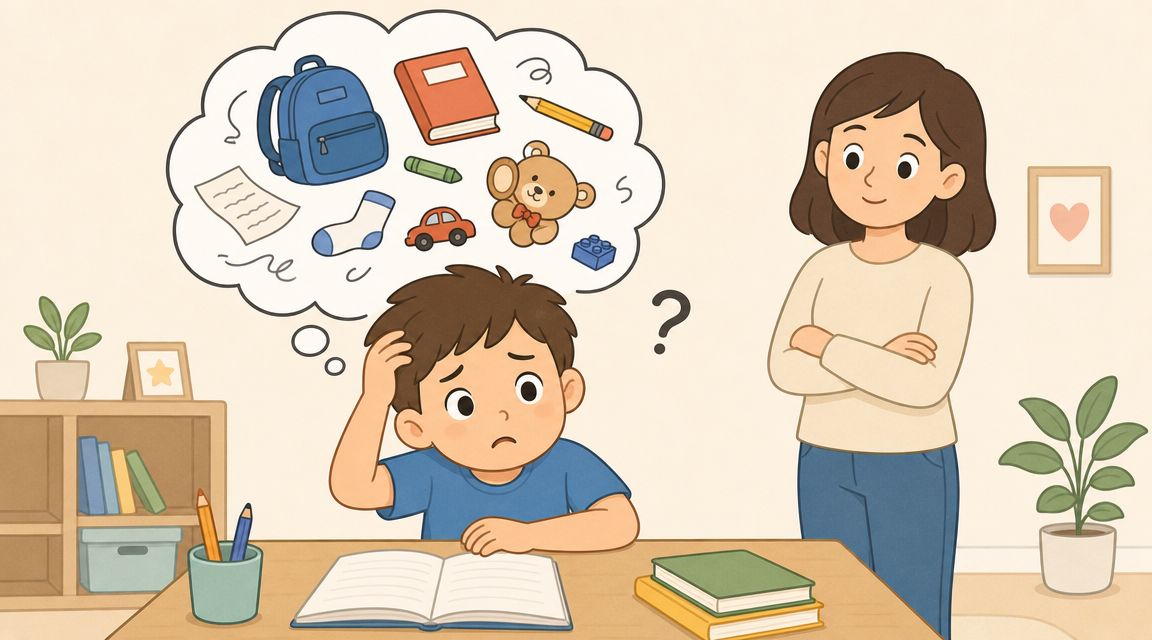
You tell your child, “Please put your shoes by the door, bring your folder, and wash your hands for dinner.” They nod. Two minutes later, one shoe is in the hallway, the folder is still in the backpack, and they're on the floor staring at a Lego piece as if the original plan vanished.
Parents often see this pattern and wonder which explanation fits. Is it defiance, distraction, laziness, immaturity, or ADHD? In many children, the missing piece is working memory, which is less about effort and more about the brain's ability to hold and use information in the moment.
When ADHD affects working memory, a bright child can sound capable, understand the instruction, and still fail to carry it out. That gap is painful for children and exhausting for adults. It can also chip away at confidence when a child starts hearing “You knew this” or “You just need to try harder.”
This article is educational and isn't intended to diagnose, treat, or replace medical advice, diagnosis, or treatment. If you're considering medications, supplements, or major diet changes, talk with a qualified healthcare professional who knows your child.
Why "Just Try Harder" Does Not Work
A child with ADHD working memory problems may want to comply and still lose the plan halfway through. That's why “try harder” so often lands badly. It assumes the problem is motivation when the problem may be mental holding power under load.
I often explain it to parents this way. Your child may have heard every word you said, but their brain couldn't keep all the pieces active long enough to organize and execute them. That's very different from refusing.
What parents usually notice first
At home, it often looks like this:
- Multi-step directions fall apart: Your child completes the first step and forgets the rest.
- Simple routines stay inconsistent: Morning tasks don't become automatic, even after many reminders.
- They lose the thread mid-task: They walk upstairs for pajamas and come back with a stuffed animal.
- You see a mismatch between ability and output: They can discuss a topic intelligently but can't get the worksheet finished.
Practical rule: If your child can explain what to do but can't hold onto the steps long enough to do it, think working memory before you think willful noncompliance.
That shift matters. Blame tends to escalate conflict. Understanding changes the response. Instead of repeating instructions louder, you start shortening them, writing them down, and building supports around the child's brain rather than arguing with it.
What compassionate support sounds like
Try language such as:
- “Let's do one step at a time.”
- “I'm writing this down so your brain doesn't have to carry all of it.”
- “You're not in trouble. Let's make this easier to remember.”
Those small changes reduce shame. They also make cooperation more likely, because children do better when the task fits their cognitive capacity.
The Brain's Mental Post-it Note
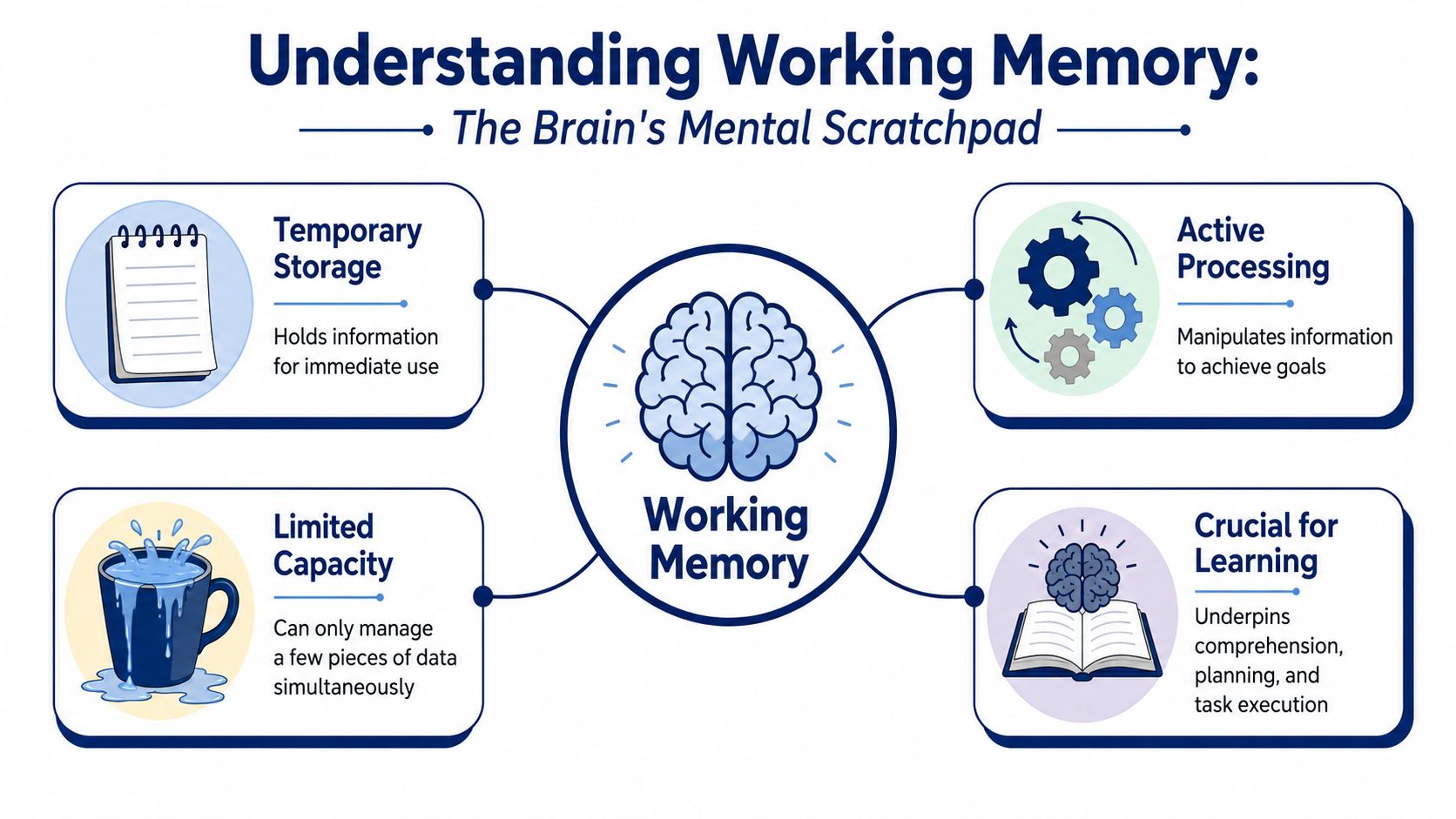
Working memory is the brain's temporary workspace. Think of it as a mental Post-it note or the brain's RAM. It lets a child hold information briefly and use it right away.
That sounds simple, but it involves two jobs at once. First, the brain has to store information for a short period. Second, it has to manipulate that information to complete a goal. A child may remember the words “math book, planner, lunchbox,” but the harder part is keeping those items active while also moving through the distractions of a noisy classroom or a rushed morning.
What working memory does all day
A child uses working memory when they:
- Follow directions: “Get your homework, then put your water bottle in your bag.”
- Do mental math: Keep numbers in mind while solving the problem.
- Write a sentence: Hold the idea, spelling, punctuation, and sequence at the same time.
- Shift between tasks: Stop one activity and remember what comes next.
- Read for meaning: Keep earlier parts of a sentence or paragraph active while processing the next part.
If that mental workspace is fragile, ordinary demands start to overload it. The child may appear forgetful, scattered, or inconsistent, but the deeper issue is that the brain's “sticky note” isn't holding enough, long enough, under pressure.
How ADHD changes that mental workspace
ADHD isn't just an attention problem. It often affects the systems that support executive functioning, including working memory. A review in Frontiers in Psychology reported that 67% to 71% of youth with ADHD showed impairment in at least one key working-memory domain, including central executive, visuospatial, and phonological systems, according to this ADHD working memory review in PubMed Central.
That finding matches what many families see. The problem isn't always constant and it isn't always obvious during simple tasks. But when the demand rises, the weakness shows up.
Working memory is where attention, organization, and action meet. If that workspace collapses, the child may know what to do and still not be able to carry it through.
Why symptoms can look inconsistent
This is one reason parents get confusing feedback. A teacher may say, “He answered great in discussion,” while another says, “She never turns in multi-step work.” Both can be true.
A child might do fine when the task is brief, visual, interesting, or externally guided. The same child may struggle when they must hold verbal information, resist distraction, and mentally sequence several steps without support.
That's also why arguing over whether a child “can” do it misses the point. Capacity changes with load. ADHD working memory problems often emerge most clearly when the brain has to hold, sort, and act at the same time.
Recognizing Working Memory Challenges in Daily Life
Working memory problems rarely announce themselves by name. They show up as everyday friction. A child forgets the second half of an instruction, loses their place while reading, starts a sentence and trails off, or seems unable to keep school materials organized.
That pattern is easy to misread as carelessness. It's more accurate to ask whether the child is being asked to carry too much information in real time.
A large NIH-hosted review found overall working-memory effect sizes in ADHD around d = 0.69 to 0.74, with evidence that slow processing speed and working-memory demands interact, especially under multitasking conditions. That helps explain why timed schoolwork, multi-step oral directions, and doing two things at once can fall apart so quickly in ADHD, as summarized in this NIH review on ADHD, working memory, and processing speed.
Common signs at home
You may notice:
- Instructions evaporate quickly: Your child starts the first step, then asks, “What was I supposed to do next?”
- Routine tasks need repeated prompts: Brushing teeth, packing a bag, or cleaning up doesn't “stick.”
- They interrupt themselves: They head to complete a task, get sidetracked, and forget the original goal.
- Emotions run high during transitions: Too many verbal demands at once can create overload, not just resistance.
Common signs at school
Teachers may describe a child who:
- Forgets assignments: Not because they never heard them, but because they couldn't hold them long enough to record them accurately.
- Struggles with note-taking while listening: Doing both at once places a heavy load on working memory.
- Makes more errors on timed work: Speed plus memory load is a hard combination.
- Looks “spacey” during multi-step tasks: The mental sequence breaks before the task is complete.
A child with weak working memory may do well in conversation and still struggle badly with execution. Talking and doing don't place the same demands on the brain.
Why mental manipulation is so hard
Some tasks ask for simple storage. Others require active mental manipulation. That's the harder category. Think of mental math, spelling while writing, holding a teacher's instructions while organizing materials, or remembering the order of steps in a science activity.
When parents track the bad moments closely, the pattern often becomes clear. Trouble spikes when the child has to listen, remember, organize, and act without an external cue. That's the signature strain of ADHD working memory problems.
Building a Brain-Healthy Foundation at Home
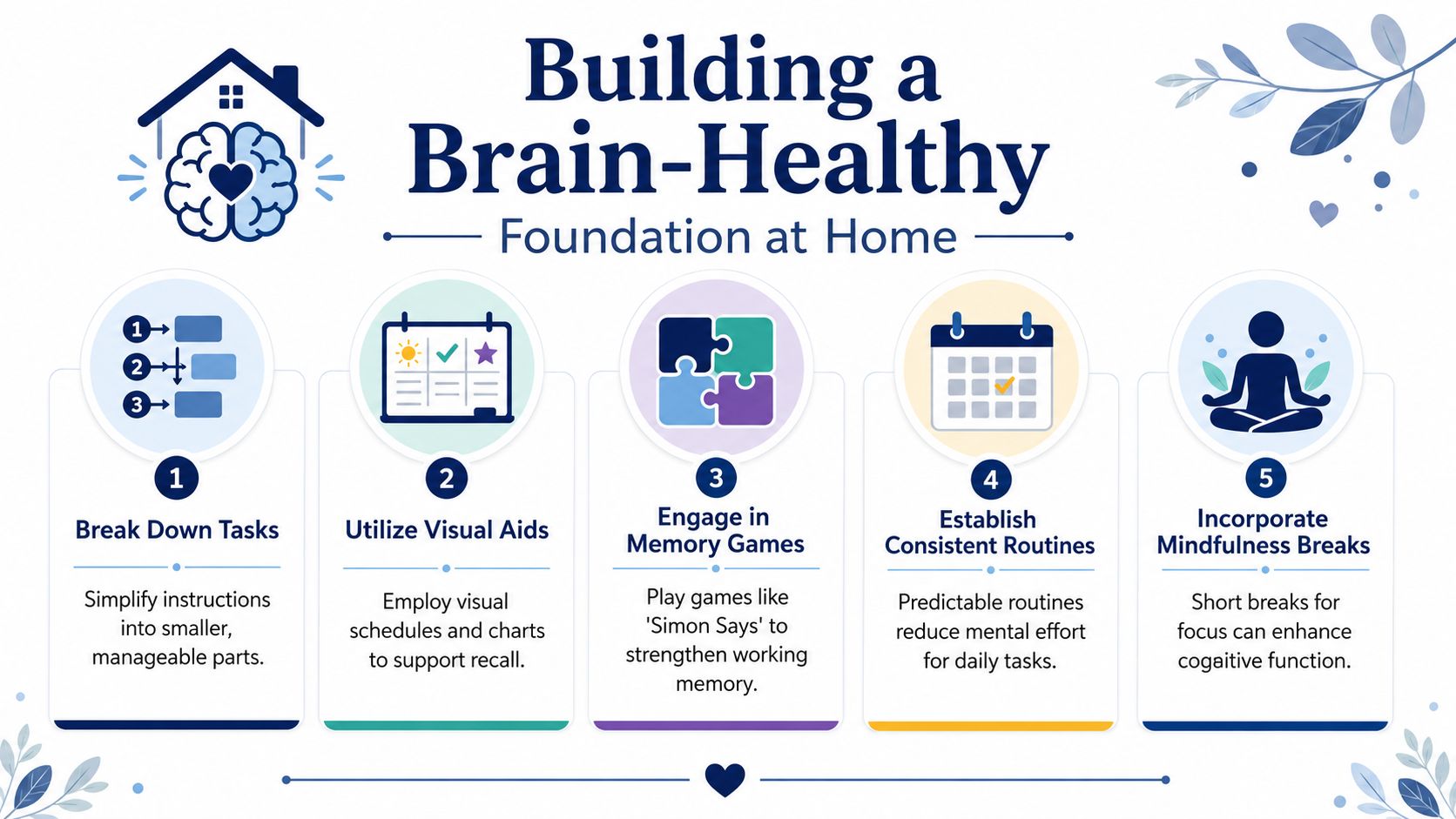
Parents can't fix working memory with one perfect trick. What helps most is building a daily environment that supports attention, energy regulation, and consistency. In practice, that means lifestyle habits, nutrition, movement, and realistic routines working together.
The goal isn't to make your child “perform” better for adults. The goal is to help their brain function with less strain.
Food that supports the brain
Children with ADHD often do better when meals are steady, predictable, and built around whole foods rather than long stretches of grazing and highly processed snacks. A practical plate looks simple:
- Protein at breakfast: Eggs, Greek yogurt, cottage cheese, nut butter, tofu, or beans.
- Fiber and slow carbohydrates: Oats, whole-grain toast, fruit, beans, brown rice, potatoes.
- Healthy fats: Avocado, nuts, seeds, olive oil, salmon, sardines.
- Colorful produce: Berries, oranges, spinach, carrots, cucumbers, bell peppers.
Affordable options matter. Frozen berries, canned salmon, peanut butter, oatmeal, lentils, eggs, plain yogurt, and bagged spinach are often easier on the budget than specialty “brain foods.”
Nutritional gaps to ask about
Not every child with ADHD has a nutritional deficiency, but it's reasonable to review basics with a clinician when symptoms are persistent, appetite is poor, sleep is off, or diet is narrow.
Topics parents commonly discuss with healthcare professionals include:
- Iron status
- Vitamin D
- Magnesium
- Zinc
- B12 or folate when diet is restricted
- Protein intake overall
These nutrients play roles in general brain and body function. They aren't a substitute for an evaluation, and supplements shouldn't be started casually just because they're sold as “natural.”
Food first is usually the best place to begin. Supplements can help in some situations, but they work best when they correct a real need or support an already solid routine.
How to think about omega-3 supplements
Omega-3s are one of the most common supplements families ask about. When parents are choosing a product, the useful questions are practical ones:
- Does the label clearly list EPA and DHA?
- Is the form one your child will take, such as liquid, mini softgel, or chewable?
- Is the ingredient list simple?
- Has the product been discussed with your child's clinician, especially if your child takes other medications or has medical conditions?
For families on a budget, a basic fish oil from a reputable store brand may be more realistic than an expensive “brain blend.” Consistency usually matters more than fancy packaging. Some children tolerate liquid preparations better, while others do best with small capsules hidden in a routine.
Exercise is a major brain-health tool
Exercise deserves much more attention in ADHD care than it usually gets. Movement can help with alertness, mood regulation, restlessness, and readiness to learn. It also gives children an outlet that lowers friction at home.
The best exercise plan is the one your child will repeat. Useful options include:
- Fast outdoor play before homework
- A family walk after dinner
- Martial arts, swimming, soccer, dance, or biking
- Short movement breaks between mental tasks
- Jump rope, mini trampoline, hallway sprints, or body-weight circuits on rainy days
For many children, exercise before school or before homework works better than waiting until the end of the day.
A short video can make this easier to visualize in real life.
Habits that quietly make symptoms worse
Some daily patterns increase cognitive strain even when they seem harmless.
- Irregular sleep: A tired brain holds less information.
- Excessive evening screen time: It can crowd out sleep, movement, and calmer routines.
- Sugary grab-and-go patterns: Rapid energy swings can amplify irritability and distractibility.
- Overscheduling: Too many transitions can overload a child who already struggles with mental organization.
Families also ask about drinks marketed for focus and energy. Caffeine products deserve caution in children and teens, and many are poorly matched to kids with anxiety, sleep issues, appetite problems, or ADHD medications. If you want a broader look at lower-stimulation beverage options and ingredients to watch, this guide on natural energy drinks Australia offers a useful consumer perspective.
Daily habits that are easy to start
A strong foundation often looks ordinary:
- Same wake time most days
- Protein-rich breakfast
- Movement before seated work
- Visible homework station
- Short work blocks with breaks
- Predictable wind-down routine
- Devices parked outside the bedroom when possible
These habits won't erase ADHD working memory challenges. They do make the brain more available for every other support you use.
Evidence-Based Strategies for School and Daily Tasks
When a child struggles with working memory, the most effective supports are often external, not internal. In other words, don't ask the brain to hold more. Change the environment so the brain has less to carry.
That approach fits the research. A detailed study of working-memory subcomponents found that the most pronounced weakness involved reordering, or mentally manipulating information. In that study, 75% of youth with ADHD were below average or impaired in this skill, which is why written steps, visual schedules, and repeated cueing are so practical, as described in this study on ADHD working-memory reordering.
What works better than telling a child to remember
The strongest day-to-day strategies tend to offload sequencing and recall:
- Written step lists: “Shoes. Folder. Water bottle. Jacket.”
- Visual routines: Morning and bedtime checklists posted where the task happens.
- Chunked assignments: One section at a time instead of a full page presented all at once.
- External capture tools: Planner, sticky note, whiteboard, phone reminder for older teens.
- Repeat-back method: Ask the child to say the instruction back in their own words.
- Reduced simultaneous demands: Don't combine listening, organizing, and speed unless necessary.
If you want examples of how visuals can reduce mental load, this guide on how to improve ADHD focus with visuals gives concrete ideas parents can adapt at home.
What usually doesn't help much
Many families are offered “brain training” programs that promise to strengthen memory. The appeal is understandable. The practical question is whether the child functions better in real life afterward.
Current expert guidance is more favorable toward offloading strategies like visual cues, checklists, and reminders than toward generic memory games as a meaningful fix for working memory in daily life. That's one reason I'd rather see a family use a whiteboard in the kitchen, a laminated backpack checklist, and a written homework sequence than spend money on a flashy app alone.
If a support lowers the amount your child has to hold in mind, it's usually worth trying. If it only asks them to “train harder,” be cautious.
Effective support strategies for ADHD working memory
| Strategy Type | Examples | Primary Goal |
|---|---|---|
| Visual supports | Whiteboard routines, picture schedules, sticky notes, color-coded folders | Reduce the need to hold steps mentally |
| Task simplification | One direction at a time, chunked worksheets, single-subject homework blocks | Lower cognitive load |
| Verbal supports | Repeat-back, brief prompts, cueing before transitions | Strengthen encoding of instructions |
| Environmental setup | Homework station, backpack launch spot, labeled bins | Cut down on distraction and searching |
| School accommodations | Written directions, reduced copying, extra check-ins, task breakdown | Improve follow-through in class |
Parents often benefit from learning more about the larger executive-function picture, since working memory rarely exists in isolation. This overview of a parent's guide to executive functions training can help you connect memory struggles with planning, organization, and self-monitoring.
What to ask for at school
A teacher doesn't need to redesign the whole classroom to help. Targeted supports often make a real difference:
- Written instructions in addition to verbal directions
- Check-ins after multi-step assignments are given
- Reduced copying from the board
- Preview of longer assignments
- Permission to use organizers, graphic supports, or checklists
- Breaking large tasks into smaller due dates
These supports don't lower expectations. They make the task accessible to the child who otherwise loses the sequence before they can show what they know.
How Medication Can Support Brain Function
Medication is often discussed as if it sits on one side of a debate. In practice, it's better understood as one tool in a broader treatment plan. For some children, it can make the brain more available for learning, planning, emotional regulation, and follow-through.
That matters because ADHD isn't only about behavior. It involves brain networks that support attention and executive functions.
How different medication groups can help
Stimulant medications are commonly used to improve attention regulation and executive control. In plain terms, they can help the child sustain focus, resist distraction, and stay connected to the task long enough to use the supports you've put in place.
Non-stimulant medications may also support attention and self-regulation, sometimes in children who don't tolerate stimulants well or who have a clinical picture where another option makes more sense.
Parents don't need to become neurochemists, but it helps to know the broad idea. These medications affect signaling in brain systems tied to dopamine and norepinephrine, which are important for focus, task engagement, inhibition, and working memory.
What medication can and can't do
Medication doesn't teach organization by itself. It doesn't automatically create routines, fix sleep, replace school accommodations, or remove the need for healthy habits.
What it can do, when it's a good fit, is reduce the noise in the system. A child may be better able to hear the instruction, hold the first step, stay with the task, and benefit from therapy, coaching, parenting strategies, and school supports.
That's why I encourage families to think in combinations, not categories. Medication plus structure. Medication plus exercise. Medication plus visual tools. Medication plus family coaching.
The best question usually isn't “Should we do medication or everything else?” It's “What combination helps this child function, learn, and feel more capable?”
If you want a clearer picture of how medication fits into integrated care, this page on medication management for ADHD outlines how clinicians typically approach monitoring, adjustment, and individualized planning.
A practical note for parents considering supplements too
If your child takes psychotropic medication or may start one, review all supplements with the prescribing clinician. That includes omega-3 products, magnesium blends, sleep gummies, herbal “calm” formulas, and caffeinated drinks. “Natural” doesn't always mean low-risk, especially when several products are combined.
Your Next Steps for a Comprehensive Evaluation
If the patterns in this article feel painfully familiar, it may be time for a more formal evaluation. That's especially true when the struggles are affecting school performance, family life, self-esteem, or your child's sense that they're always falling behind despite trying.
A professional assessment helps because ADHD working memory problems aren't always obvious in every setting. A child may do well with one-step requests and then fall apart when a task becomes more complex.
Why testing can clarify the picture
A 2021 review noted that working memory is not universally impaired in ADHD, and that performance can vary depending on task demands such as load and complexity. That's one reason symptoms can look inconsistent across home, school, and testing situations, as explained in this review on task-dependent working memory performance in ADHD.
This is also why casual observation only goes so far. Parents and teachers usually see the outcome. A careful evaluation helps identify the mechanism underneath it.
What a comprehensive evaluation often includes
A good assessment usually looks at several layers together:
- Developmental and psychiatric history
- Current symptoms across settings
- School functioning and teacher feedback
- Attention and executive-function patterns
- Mood, anxiety, sleep, and behavior
- Learning or language concerns when relevant
- Review of diet, routines, exercise, and other health factors
That broader lens matters. A child may have ADHD working memory challenges, but sleep disruption, anxiety, academic frustration, or a narrow diet can intensify what parents see day to day.
When to seek help sooner
Consider moving forward more promptly if:
- Your child's confidence is dropping
- Homework has become a nightly battle
- Teachers report a widening gap between understanding and output
- You're relying on constant reminders just to get through basic routines
- Emotional outbursts increase around school tasks or transitions
For families who want a clearer sense of what formal assessment involves, this guide to the ADHD evaluation process can help you know what to expect.
An evaluation doesn't label a child as broken. It gives the adults a map. Once you know whether working memory, attention regulation, anxiety, learning differences, or several factors are interacting, support becomes more precise and much less frustrating.
If your child is struggling with attention, follow-through, school performance, or possible ADHD working memory issues, Children Psych offers compassionate, evidence-based care for children and teens across California. Families can access thorough evaluations, therapy, medication management, and telehealth support designed to fit real life.